



Sem produtos
Produto adicionado ao seu carrinho de compras
Existem 0 produtos no seu carrinho. Existe 1 produto no seu carrinho.
 Ampliar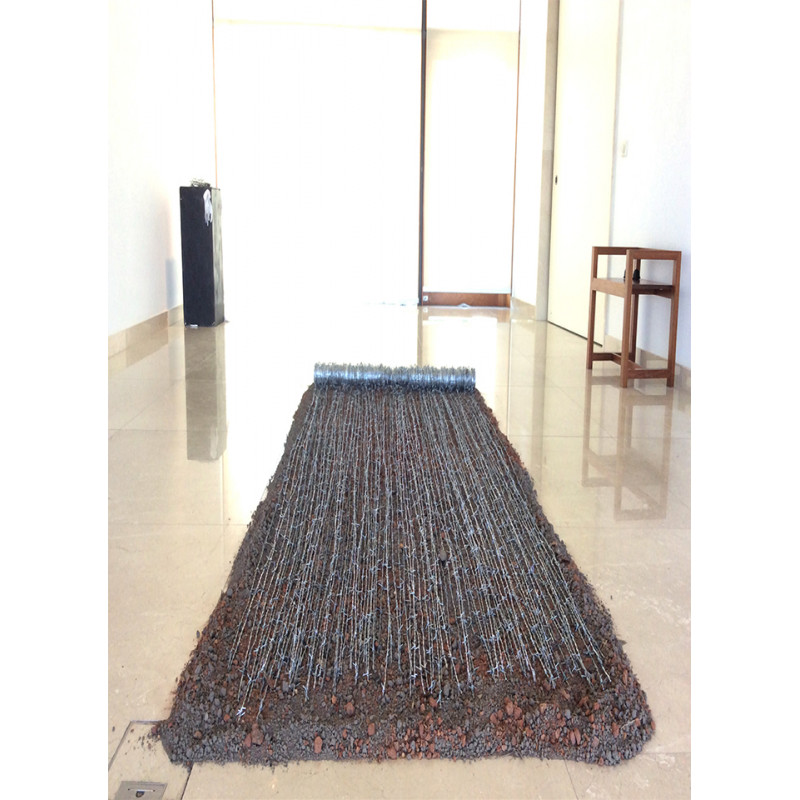
BABU (ANG)
Instalação / Installation
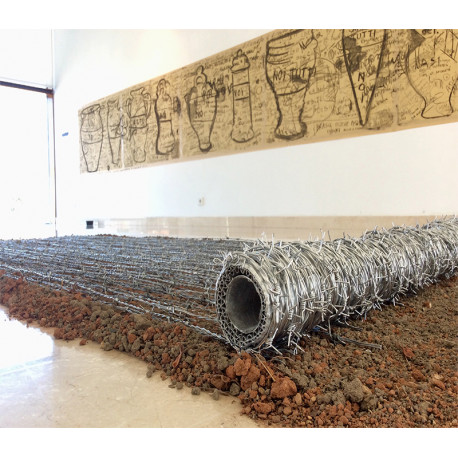
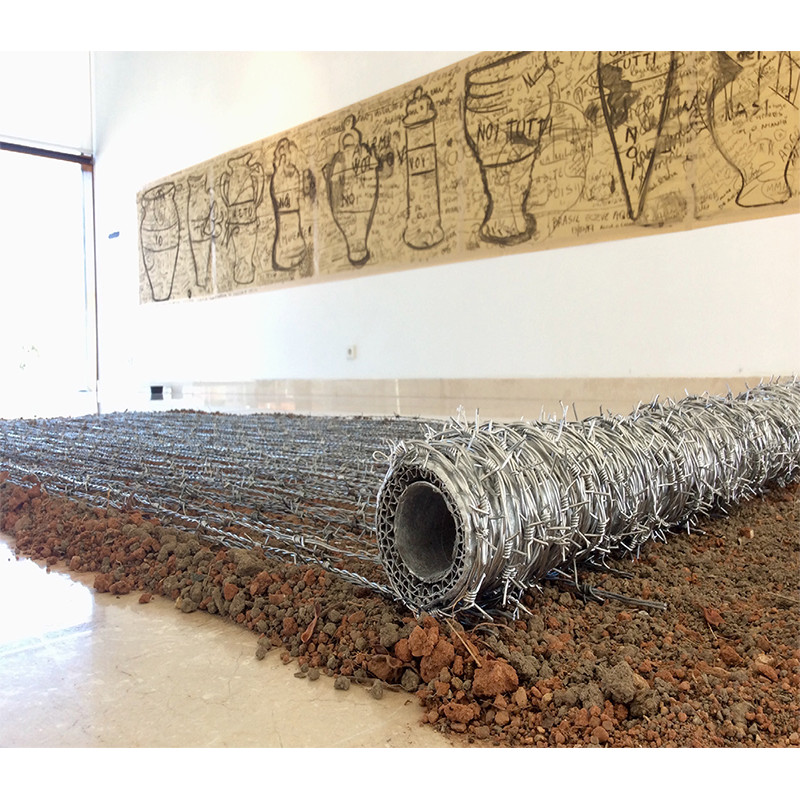
Babu possui um repertório que navega entre a pintura e outras linguagens das artes visuais contemporâneas. Trata-se de um artista experimental, com muitas e potentes possibilidades expressivas. Na mostra ACERTO, com curadoria de Nelson Ricardo Martins, Babu traz a baila uma temática associadas a intolerância, repressão, migração e racismo, tendo o arame farpado como símbolo máximo dessas questões. Para compor os conceitos afetos a investigação implementada, ACERTO possui arquitetura que abarca quatro linguagens. São elas: A escultura, pintura, video e livro de artista. O vídeo BABU, realizado por Nelson Ricardo Martins, que entrevistou o artista por cerca de 4 horas, está sendo apresentado pela primeira vez. Trata-se de um recorte abarcando um impressionado relato de Babu sobre a sua infância / adolescência em meio a guerra civil Angolana (1975-2002)
Babu has a repertoire that navigates between painting and other contemporary visual arts languages. He is an experimental artist, with many and powerful expressive possibilities. At the ACERTO exhibition, curated by Nelson Ricardo Martins, Babu brings up a theme associated with intolerance, repression, migration and racism, with barbed wire as the ultimate symbol of these issues. In order to compose the concepts related to the implemented research, ACERTO has architecture that embraces four languages. They are: Sculpture, painting, video and artist's book. The video BABU, made by Nelson Ricardo Martins, who interviewed the artist for about 4 hours, is being presented for the first time. This is an excerpt covering an impressed account by Babu about his childhood / adolescence in the midst of the Angolan civil war (1975-2002)
ACERTO
[A exposição “ACERTO” foi exibida no Mosteiro de Santa-Clara-A-Velha, Coimbra, Portugal, do dia 06 de julho a 02 de setembro de 2019 com curadoria de Nelson Ricardo Martins]
"Eu gosto de comparar o ser humano com alguns
animais. Por exemplo, o artista é como o caracol
do mar. O caracol do mar não constrói concha, ele
ocupa as conchas. Quando a concha já não for
agradável, ele sai da concha e vai buscar outra".
Babu
Babu navega pelo experimental na busca de possibilidades que estejam conectadas ao fio que jazz Milles Davis entre a mente e o coração. Decerto, há Harmonia perceptiva que se insere no atravessamento da pele: corte profundo. Acerto trafega pelas vias repertóricas no manejo de múltiplas engrenagens fusionadas em uma instalação. São pensamentos, elocubrações, tentativas, decisões.
Podemos, assim, supor, no seio do espaço expositivo, o visitante, com seu corpo-cinema, a praticar um olhar-travelling entre a pintura-écran com projeções de imagens do processo e o livro de artista ao fundo, um contraponto necessário entre os suportes. Ou mesmo, com o seu corpo-performance, a vagar cuidadosamente no estreito intervalo que se mede da parede a estrutura-arame-farpado. E esse risco que se forja entre as linguagens que invadem fronteiras, se constituindo em híbridos a bailar coesos e tencionados em espesso caldo expressivo, representa, para Babu, de forma poética, o seu acerto com o mundo. Nesse campo, invadir outras cartografias, não significa a morte eminente, mas a norma pulsante, o mergulho em novos e seguros caminhos, onde habita a arte em conexão com o desejo. Aqui há Fifty-Eight de John Cage. Não cabe mais a bala mortal que paira ao pé do ouvido, o morteiro que dialoga com a histeria. O momento é outro, não sendo possível o simulacro da própria castração, como o fez o genial artista austríaco Rudolf Schwarzkogler, ligado as ativistas vienenses. A verdade nua e crua é que interessa, me desculpe Orson Welles. O abismo se inicia em uma fenda Matta-Clark, rumo ao vazio.
O recorte curatorial de Acerto foi no sentido de colaborar com o artista, buscando potencializar as suas ideias, suscitar referências, engendrar novas questões. Acerto se configura em uma proposta que possui, não só o viés afeto a arte experimental, traduzida a partir do movimento que o artista faz, da pintura em direção a outras linguagens, como, também, a arte política. Foi pensando, sobretudo, no segundo esteio de possibilidades que realizei uma entrevista em vídeo com Babu. Por duas horas o artista africano me contou em um único e extenso “grito” a sua fantástica trajetória de
vida: imigrante ainda bebê, com dois anos, estudante de dança em uma Angola conflagrada pela guerra civil, a morte de dois irmãos em combate, a prisão sem provas e a vida reconstruída a partir da paixão pela mulher portuguesa. A seguir, alguns trechos da entrevista.
"Eu gosto de comparar o ser humano com alguns animais. Por exemplo, o artista é como o caracol do mar. O caracol do mar não constrói concha, ele ocupa as conchas. Quando a concha já não for agradável, ele sai da concha e vai buscar outra".
“Toda a fronteira é uma passadeira e há sempre arame farpado. O arame farpado é uma narrativa da minha experiência pessoal. O arame farpado persegue-me desde os dois anos de idade”.
“A guerra em Angola foi uma coisa horrível. Toda criança Antes de completar 18 anos, já sabia desmontar e montar uma Makarov e uma AK 47. Meus irmãos não sobreviveram a guerra”.
“Eu estava estudando dança nessa época. E eu tinha uma vida normal apesar da guerra. O ser humano é uma animal de hábitos”.
“O arame farpado é a imaculização da passadeira vermelha para a branca. Porque, quando a gente olha para Hollywood, há muita gente a morrer, a sofrer, para aquela gente passar por cima daquela passadeira vermelha, pra mostrar os vestidos, mostrar os diamantes. Há crianças que foram cortados os braços por causa da porra do diamante. Não existe diamante limpo no mundo”.
“Arte contemporânea é um caminho a seguir. Eu não saí da pintura. O que está na tela vai para o chão, para a parede e pode ir para o ar. É um segmento de coisas, de sentimentos, de vivências, de observações, de críticas, de narrativas que estou a seguir”.
“O que que é contemporâneo, o que que é tribal? Porque simplesmente uns indivíduos chegaram em meupaís e disseram: “isso aqui não é cidade, é tribo". Foi isso que aconteceu com a África. Nós temos a nossa ideologia que é apagada”.
“Conheci a minha mulher, Luisa Francisco, em Coimbra, em 1999. Em 2001 nós ficamos juntos e me mudei definitivamente para Coimbra”.
“Cheguei numa fase que não quero pintar para mostrar que é bonito. Quero falar de coisas diferentes; de coisas que me tocam. Quero sair um pouco da pintura pois quero expressar coisas que vi, que continuo a ver. Eu acho que a pintura só não chega”.
“A minha relação com as pessoas, com a minha família, é normal. Sou um pai, tenho uma filha que eu adoro. Tem a minha mulher que eu adoro. Somos um casal normal; temos nossos altos, baixos. Eu gosto de Coimbra; quando estou fora de Coimbra, só penso em Coimbra. É uma cidade que criei família sem cor. Todo mundo gosta de mim, todo mundo fala de mim. Quando não estou em Coimbra, vão perguntar onde estou."
Nelson Ricardo Martins
Artista-curador
ACERTO
[The exhibition "ACERTO" was shown at the Santa-Clara-A-Velha Monastery, Coimbra, Portugal, from July 6 to September 2, 2019, curated by Nelson Ricardo Martins]
"I like to compare human beings with certain animals like
the. For example, the artist is like the sea snail. The sea snail
does not build a shell, it occupies other shells.When the shell
is no suitable, it leaves the shell in search longer of another."
Babu
Babu navigates through the experimental in search of possibilities that are connected to that thread that Jazz great Milles Davis saw as running between the heart and mind. Certainly, there is perceptive Harmony that passes over the skin: a deep cut. Agreement passes through the repertoire routes of the multiple fused gears in one installation. They are thoughts, meditations, attempts, decisions.
We can therefore assume, within the exhibition space, the visitor, with his body-cinema, to exercise a traveling- gaze between the paint-screen with projections of process images and the artist's book in the background, a necessary counterpoint between the supports. Or even, with their body-performance, they wander carefully in the narrow space between the wall and the barbed-wire fence. It's that risk that is forged between the languages that invade borders, becoming hybrids to dance cohesively and intentionly in a thick soup, which represents for Babu, poetically, his I'm right with the world. In this field, to invade other territories, does not mean eminent death, but is the pulsating norm, bursting into new and safe paths, where art dwells in connection with the desire and wish. Here's John Cage's Fifty-Eight. The deadly bullet that hangs near the ear no longer has room, the killer in dialogue with hysteria. This is another moment, and it is not possible to simulate castration, as did the brilliant Austrian artist Rudolf Schwarzkogler, linked to Viennese activists. The raw, naked truth is what matters, I'm sorry Orson Welles. The abyss begins in a Matta- Clarkcrevice heading to emptness.
The curatorial cut of On Target was in the sense of collaborating with the artist, seeking their ideas, raising references, generating new questions. On Target is set in way of proposalwhich has, not only the affection bias to experimental art, translated from the movement that the artist makes from painting towards other languages, but as well as political art. It was thinking, above all, in the second mainstay of possibilities that I did a video interview with Babu. For two hours the African artist told me in a single and extensive "cry" his fantastic trajectory of life: an immigrant who is still a baby, a two-year-old dance student in an Angolan civil war, the death of two brothers in combat, imprisonment without evidence and a life rebuiltfrom of the passion for the Portuguese woman. Here are some excerpts from the interview.
"The whole border is a highly visible crosswalk and there is always barbed wire. Barbed wire is a narrative of mypersonal experience. Barbed wire has chased me from the age of two.”
"The war in Angola was a horrible thing. Every child Before he turned 18, knew how to take apart and reassemble a Makarov and an AK 47. My brothers did not survive the war.”
“I was studying dance at this time. And I had a normal life despite the war. The human being is a creature of habits.”
"Barbed wire is the immaculation of the red to white treadmill. Because when we look at I like to compare human beings with certain animals like the. For example, the artist is like the sea snail. The sea snail does not build a shell, it occupies other shells.When the shell is no suitable, it leaves the shell in search longer of another. Hollywood, there are many people dying, suffering, for those people to go over that crosswalk red, to show the dresses, to show the diamonds. There are children who had their arms cut off because of these fucking diamonds. There is no clean diamond in the world. ”
“Contemporary art is a just another way forward. I did not get out of the painting. What's on the screen can go to the floor, to the wall or can go into the air. It is a segment of things, of feelings, of experiences, of observations, of criticism, of narratives that I am following.”
"What is contemporary, what is tribal? Simply because some individuals came into my country, and said, "This is not a town here, it's a tribe. This is what happened to Africa. We have our ideology that has been erased.
"I met my wife, Luisa Francisco, in Coimbra in 1999. In 2001 we got together and I moved to Coimbra to stay.”
“If everyone looked at others the way I look, we would not need barbed wire.”
"I arrived at a stage where I do not want to paint to show that something is beautiful. I want to talk about different things; about things that touch me. I want to depart a bit from painting because I want to express things that I've seen, and continue to see. I think painting is not enough.”
“My relationship with other people, with my family is normal. I'm a father, I have a daughter that I adore. There's also my wife that I love. We are a normal couple; we have our ups and downs. I like Coimbra; When I'm out of Coimbra, I only think of Coimbra. It's a city that created a family without color. Everyone likes me, everyone talks about me. When I'm not in Coimbra, they'll ask where I am."
Nelson Ricardo Martins
Artist-curator
| Artista / Artist | Babu |
| País / Country | Angola / Angola |
| Título da Obra / Title of the Work | ACERTO |
| Data / Date | 2019 |
| Linguagem / Mediums | Instalação / Installation |
| Informações Complementares / Additional information | “ACERTO” foi exibida no Mosteiro de Santa-Clara-A-Velha, Coimbra, Portugal, do dia 06 de julho a 02 de setembro de 2019. |
