


Sem produtos
Produto adicionado ao seu carrinho de compras
Existem 0 produtos no seu carrinho. Existe 1 produto no seu carrinho.
 Ampliar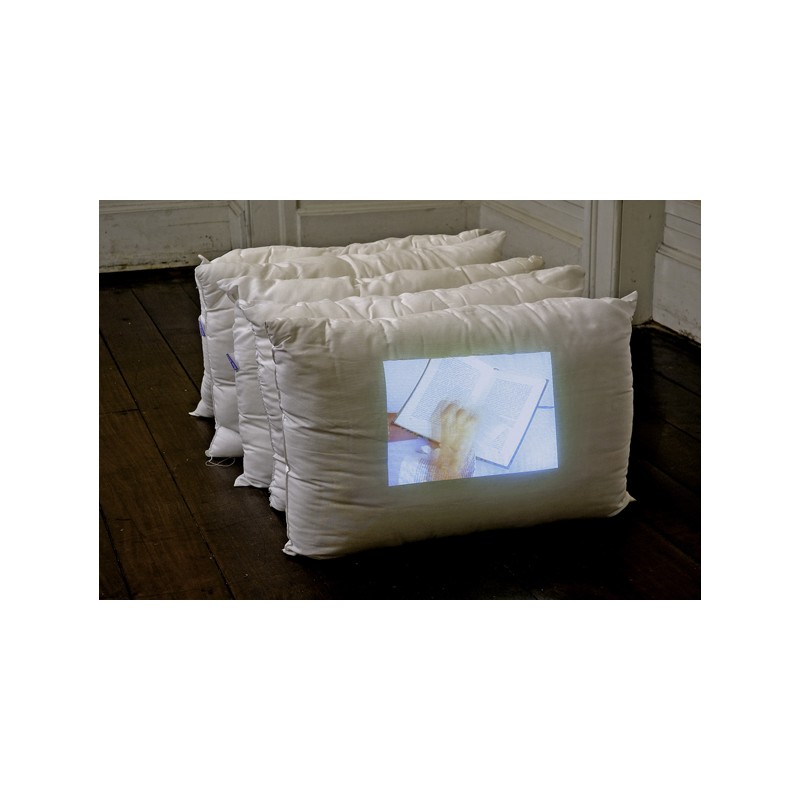
Exposição Livros
Exposição
[HELENA TRINDADE]
Exposição LIVROS, 2008
Castelinho do Flamengo _ Rio de Janeiro
Curadoria de Alberto Saraiva
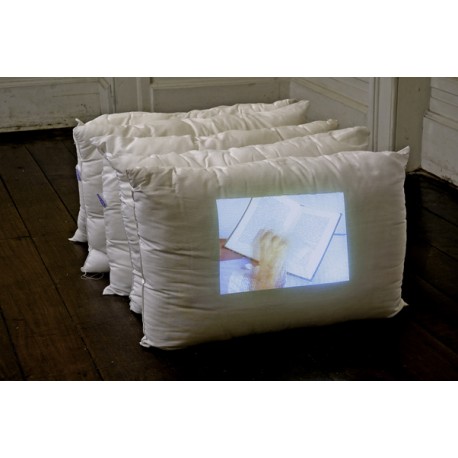
Instalação Quarto do Sonho, 2008
15 m2
Projeção sobre travesseiros dos vídeos:
A carta roubada
A origem da obra de arte
Foto de Beto Felício

INSTALAÇÃO QUARTO DO ORÁCULO
Vários objetos relacionados ao funcionamento da linguagem
15 m2
Foto de Beto Felício

INSTALAÇÃO QUARTO DO TEMPO
18 m2 - Projeção do vídeo Ironia
Foto de Beto Felício

INSTALAÇÃO CORREDOR PARA A CARTA EVANESCENTE
Versos-inversos _Poema a Picabia + voal nas janelas e portas
13 m2
Foto de Beto Felício
Detalhe: Versos-inversos_Poema a Picabia
Vestígios de grafite resultantes da cópia do extenso poema Pensamentos sem linguagem de Francis Picabia
30 x 21 cm
A CARTA ROUBADA _ vídeo 3:20 min
A CARTA ROUBADA
Tania Rivera
“A carta/letra me foi roubada, a carta passa de mão em mão, jamais é lida; talvez seja ela, estranhamente, que me lê.
No célebre conto de Poe, A carta roubada é a principal personagem. Mas nunca se revela o que nela estava escrito. Aquele que a tem em mãos vê-se transformado, à revelia, tomado no jogo da carta/letra. Lacan sugere que a carta roubada é, para cada um, seu inconsciente
O que poderia o sonho gravar no travesseiro?
(a letra/carta chega sempre a seu destino, como diz Lacan).
O livro nasce de suas páginas arrancadas.”
A casa da letra in TRINDADE, Helena 2009: LIVROs. Rio de Janeiro, @contracapaeditora
Câmera @andresheikarte
Edição @arte.helenatrindade e @marcoscastilho
A origem da obra de arte
A ORIGEM DA OBRA DE ARTE
Tania Rivera
‘A Origem da Obra de Arte’ de Helena é um livro cujas folhas repetem seu título, sua promessa jamais cumprida. Em seu centro, seu miolo, duas páginas estão em branco. Não se trata mais de um livro, propriamente falando, mas de um objeto-clareira, encarnando em seu papel a vacuidade em que Heidegger situa a origem, a essência – da arte e do homem. Esse livro é um lugar vazio diante do qual só se pode fazer o gesto gratuito, e no entanto fundamental, de passar suas páginas, uma a uma, sem cessar – “a tarefa”, aponta Heidegger, “consiste em ver o enigma”; repetidamente –, para no final ser convidado, por sua capa duplicada, a refazer esse trajeto de ponta-cabeça, traçando com o livro uma fita de Moebius, aquela curiosa figura topológica que subverte o espaço por não ter distinção entre interior e exterior.
Max Bill, Escher e outros trabalharam plasticamente essa lógica poética da fita, pela qual também caíram de amores Jacques Lacan e nossa Lygia Clark (ver seus Caminhando e Diálogo de mãos). Para Helena, interessa na fita o fato de, nela, começo e fim estarem em continuidade, o que destrói, ironicamente, qualquer possibilidade de se pensar em uma origem. Temos aqui um Caminhando sem papel e tesoura, mas com Heidegger. Como a proposição de Lygia, ‘A Origem da Obra de Arte’ de Helena ressalta a desmaterialização da obra em prol do ato capaz de retomar o enigma da experiência estética – mas pelo viés da impossibilidade de leitura.”
.
A casa da letra in TRINDADE, Helena 2009: LIVROs. Rio de Janeiro, @contracapaeditora
.
A ORIGEM DA OBRA DE ARTE _ vídeo 3:40 min
Câmera @andresheikarte
Edição @arte.helenatrindade e @marcoscastilho
__________________________________-
TEXTO CURATORIAL
A PALAVRA ROUBADA
Marisa Flórido Cesar[1]
Páginas arrancadas de um livro retornam, uma a uma, a seu lugar de origem. Apenas ouvimos o som – ao revés – do rasgar e amassar das folhas. Apenas vemos as mãos no movimento de devolução das páginas. Sabemos, ao final do vídeo, de que se trata: do conto A carta roubada, de Edgar Allan Poe. Vemos a última (primeira) página – aquela que traz o título como índice de seu conteúdo e o nome do autor que o assina – enfim restituída. Mas restituída apenas virtualmente, na reversão do vídeo. A página roubada retornada somente em sonho.
No Quarto do sonho, como foi batizado por Helena Trindade um dos cômodos do Centro Cultural Castelinho do Flamengo, outro vídeo, sobre outro livro, acompanha A carta roubada, ambos projetados sobre pilhas de travesseiros. Várias mãos e vozes folheiam e comentam um livro como uma Babel que aos poucos projeta sua suave ruína. O livro, A origem da obra de arte, reproduz a edição portuguesa do livro de Heidegger, mas dele foram retirados as referências a seu autor e o conteúdo de suas páginas: apenas a capa, que traz o título da obra, repete-se em seu interior.
Helena Trindade vem concentrando sua investigação artística na materialidade da escrita, na tensão entre o enunciável e o visível, no intervalo em que se tramam e desarticulam palavra e coisa, imagem e texto, opacidades e transparências. Uma falha que expõe a inexistência de um laço originário e natural entre o nome e aquilo que ele significa, a inexistência de um Texto original que nos assegurasse uma tradução precisa do homem e do mundo que ele habita, tal como anunciou Nietzsche, tal como constatou a palavra fragmentada desenhando a página branca de Mallarmé. “No fundo, o mundo foi feito para acabar num belo Livro”, disse o poeta. Ao procurar a palavra que encerrasse todo discurso possível, a origem do ato de nomear, Mallarmé encontrou o acaso.
Roubar o privilégio dos deuses, a origem do ato de nomear: assim poderíamos definir a escrita que, em muitos mitos, nasce do sonho de subtrair dos deuses o poder de revelação, de saquear-lhes a palavra que desvendasse os segredos, de conjurar efemeridades e silêncios. Foi assim que Cage Jie, na China, ao desenhar os primeiros caracteres, despertou a fúria dos deuses. Ou que Moisés, ao descer do Monte Sinai e deparar-se com o Bezerro de Ouro, destruiu o ídolo e quebrou as Tábuas da Lei. Dádiva divina imediatamente retirada: a escrita, retornando à ilegibilidade, exigia um legislador e devolvia à Voz sua ascendência. Estar próximo à Voz é estar em presença da origem, é garantir o lugar de enunciação, a autenticidade de quem fala, a destinação inequívoca e sem desvios do sentido àquele a quem se fala. Eis o prestígio da origem: se nada a antecede, justifica-se em si mesma.
Dádiva dos deuses ou transgressão de um interdito, a escrita encerra ilegibilidades de fundo ou, se preferirmos, silêncios. O risco desse desconhecimento levaria Platão à condenação da escrita em Fedro. Para Sócrates, ao contrário do discurso falado que “observa as características dos futuros ouvintes”, a escrita “não sabe diante de quem convém falar ou calar-se”. Distante da origem, do lugar seguro de sua enunciação, o texto escrito conduziria a um número ilimitado de interpretações, com duvidosos sentidos. Em vez de auxiliar a memória, conduziria ao esquecimento da Verdade. Em sua falácia, os dois simulacros, a escrita e a pintura, permanecem gravemente calados, são irmãos na mesma “eloqüência bastarda”.
A alusão da artista aos dois livros – A carta roubada e A origem da obra de arte – explicita o caráter dúbio da escrita: ser a transgressão de um interdito, desejar apoderar-se da revelação da Palavra originária, mas permanecer eternamente ilegível.
O conto de Poe constrói-se em torno de uma carta roubada de uma provável aristocrata (e o soberano, como sabemos, é o representante divino na terra) que encerra um perigoso segredo, de sua recuperação e devolução. Ainda que o desvio seja corrigido ao final do conto, o conteúdo e o legítimo proprietário daquela carta permanecem velados. Ainda que as páginas do livro sejam devolvidas no vídeo de Helena Trindade, o retorno à página inicial, a devolução a seu contexto de origem não é mais que um artifício do vídeo, não é mais que um devaneio da arte. Confrontar as páginas subtraídas em um vídeo é cotejar a consistência enigmática da palavra dobrando-se sobre si mesma no outro vídeo/livro (A origem da obra de arte): qualquer decifração é anulada no reflexo repetido das páginas. Os duplos da representação, a linguagem e a arte, interiorizando a própria duplicidade. Repetição que não nos conduz a qualquer revelação originária – quem fala, o que fala, para quem? –, mas reenvia-se, dobrando-se e perdendo-se em sua própria armadilha.
Uma interrogação atravessa o Quarto do sonho: como pensar a origem já que não se pode virar a página da metafísica? Como pensá-la evitando o prolongamento e a presença de um fundamento, que permaneceria recalcado apesar dos discursos de seu fim? Como repensá-la sem devolver-lhe um valor fundador, que segue alimentando seus espectros?
A artista nomeou cada cômodo do Centro Cultural, espacializando a palavra: na Biblioteca encarnada, letras vermelhas enchem a lareira e cobrem o solo de um ambiente que nos engole como uma garganta lúgubre e asfixiante, como se a Palavra Encarnada em sua dupla natureza, voz e ícone, invisibilidade visível, se perdesse pervertendo-se no próprio balbucio. Chama-se “inferno”, aliás, o local, de acesso restrito nas bibliotecas, onde estão encerradas obras de conteúdo licencioso e proibido.
Na Biblioteca negra, sobre as paredes pretas, a fotografia do livro de Poe com as páginas do conto arrancadas e o espelho que a reflete desdobram ausência e luto. Na Conversa na Escadaria, teclas de máquinas de escrever constroem uma rede de letras que ecoam sua tagarelice – visual – no vão da escadaria.
No Quarto do oráculo, objetos curiosos, como peças retiradas de máquinas de escrever obsoletas e similares, tecem, com a palavra que o intitula, jogos repletos de humor. Na combinação inusitada entre os signos visuais e lingüísticos, quimeras vêm povoar o edifício: Oráculo é uma boca banguela em que as teclas de uma máquina de datilografia foram arrancadas incapacitando qualquer escrita ou som de teclar; Poema a Derrida é um serrote cujos dentes são letras, alusão ao perigo cortante de uma escrita recalcada pelo fonocentrismo e logocentrismo na cultura ocidental como disse o filósofo: a escrita arranca a interioridade da fala – a consciência do sujeito, o pensamento do Ser, o significado transcendental manifestam-se por excelência na voz. O “Penso, logo existo” cartesiano é ouvir a consciência de si, é ouvir-se falar. Recalcada e secundária, concluiu Derrida, a escrita tornou-se, no Ocidente, a tradutora de uma fala originária, plenamente presente: presente a si mesma, ao significado, a quem fala.
No Castelinho do Flamengo, Helena Trindade arquiteta uma Babel às avessas, uma Babel que se regozija com seu colapso. Afinal, para Derrida, o filósofo referido pela artista, a linguagem universal que o Ocidente sonhou não é o projeto da torre de Babel. A própria filosofia nasce de seu colapso, da falha fundamental que a metafísica por tentativas diversas tentará reparar. Reencontrar a origem e sua verdade, a “tradução” perfeita – esse seria o objetivo da metafísica.
O topos unívoco de Babel tampouco é o corpo da linguagem, da filosofia ou mesmo da arte, acrescentaríamos. A universalidade é um desejo. O ideal de um edifício acabado esteve suspenso em uma reconstrução interminável, em que os princípios filosóficos seriam deslocados recorrentemente, os modelos artísticos seriam repropostos continuamente: em discursos ambíguos, em traduções que alteram e subvertem os textos originais, nas querelas e disputas infindáveis da arte.
Em torno desse colapso, aventuram-se as escritas e as artes, confrontam-se as inumeráveis leituras, do texto, que o acendem, as incontáveis cintilações que fulguram no horizonte da visualidade. Explorar esse colapso, essa falha fundamental entre o que se vê e o que se fala, foi também o que fizeram Magritte e Duchamp, a poesia concreta e a arte conceitual. Se Magritte interrogou linguagem em sua relação com o que as imagens pictóricas representam, Duchamp questionou o objeto e a própria definição de arte em relação à linguagem. Mais do que expor a aleatoriedade do signo, Duchamp radicalizaria essa interrogação ao definir a “arte” por um ato de nomeação de um objeto qualquer: a obra de arte não se funda sobre condições a priori, mas como uma nomeação a ser acordada durante sua recepção a posteriori. Ao tornar o ato de nomeação ostensivamente arbitrário, mas potente, Duchamp desqualifica a construção da verdade da obra de arte, expondo a inexistência de uma articulação natural entre a verdade das coisas e a verdade dos discursos.
É nessa genealogia que Helena Trindade se inscreve. A artista invade as artes visuais com a escrita para desvelar os pontos cegos que as sobressaltaram, as opacidades que as artes por séculos tentaram recalcar. A artista invade a escrita com as exterioridades da arte para fazer emergir as ilegibilidades que a assombram: como o segredo da palavra roubada (não o inconfesso do autor, mas a espessura silenciosa e sem sentido da palavra secularizada), como a ausência de uma origem na repetição que apaga o Sujeito enunciador, como a eterna diferenciação que insurge dessa repetição sem fim.
À interrogação que atravessa o Quarto do sonho – como evitar o pensamento de origem, que segue como espectro prolongando a presença de um fundamento, já que não podemos virar a página da metafísica? – Helena responde engajando novas relações entre os termos dialéticos. Sem privilegiar um ou outro, explora o “entre” e seus “indecidíveis” como diria Derrida: entre voz e escrita, entre palavra e coisa, imagem e texto, opacidades e transparências. O que também significa dizer: nem um, nem outro, mas o intervalo entre eles. O intervalo onde se aloja o ilegível que abre a escrita à legibilidade infinita. O intervalo que acolhe as opacidades para abrir a arte aos encontros ilimitados entre o visível e o enunciável. Um intervalo de indeterminação e casualidade, que confidencia, na arbitrariedade geral dos signos, a cesura ou a complexa urdidura entre ver e falar.
Rio de Janeiro, dezembro de 2008
[1] Crítica de arte e curadora independente, é doutora em História e Crítica de Arte pela EBA/UFRJ. Curadora das exposições "Arte e Música" em parceria com Luisa Duarte, 2008 (Caixa Cultural do Rio de Janeiro, São Paulo e Brasília).
Possui textos publicados em catálogos e livros, entre os quais: “A partilha paradoxal do indeterminado” in Nova Arte Nova [org. Paulo Venancio. Rio de Janeiro: CCBB, 2008] e “Fronteiras móveis” in Crítica de Arte no Brasil: Temáticas Contemporâneas [ org. Glória Ferreira. Rio de Janeiro: Funarte, 2006].
___________________________________________
THE STOLLEN WORD
Marisa Flórido Cesar[1]
Torn pages of a book are returned, one by one, to their place of origin. All we hear is the sound – in reverse – of the pages being torn and crushed. All we see are the hands moving to return the pages. By the end of the video, we know what it’s all about: the short story The Purloined Letter, by Edgar Allan Poe. We see the last (the first) page – the one that shows the title as evidence of its content and the name of the author who signs it – finally restored. But only virtually restored, in the original reverse play of the video. The stolen page returned only in dream.
In Quarto do Sonho (Dream room), as Helena Trindade baptized one of the rooms at Castelinho Cultural Center, another video, about another book, is shown along with The purloined letter, both projected on piles of pillows. Several hands and voices turn pages and make comments about a book, like a Babel that little by little projects its ruin. The bookis a reproduction of the Portuguese edition of Heidegger’s The Origin of The Work of Art, but both the references to the author and the content of its pages have been removed: only the cover, which shows the title of the work, is repeated inside.
Helena Trindade concentrates her artistic investigation on the materiality of writing, on the tension between the enunciable and the visible, on the gap where word and thing, image and text, opaqueness and transparences are weaved and disarticulated. A flaw that exposes the inexistence of an original and natural bond between the name and its meaning, the inexistence of an original Text that would assure us a precise translation of man and the world he inhabits, as Nietzsche announced, as ascertained by Mallarmé’s fragmented word drawing a blank page. “Everything in the world exists in order to end up as a book”, the poet said. In his search for the word that would contain all possible discourse, the origin of the act of naming, Mallarmé found chance.
Stealing a privilege of the gods, the origin of the act of naming: this is how we could define the writing that, in several myths, is born out of the dream of subtracting from the gods the power of revelation, of taking from them the word that would unveil the secrets, of conjuring ephemeralities and silences. That’s how, in China, Cage Jie stirred up the wrath of the gods when he drew the first characters. Or how Moses, as he came down from Mount Sinai and saw the Golden Calf, destroyed the idol and broke the Tablets of the Law. A divine gift immediately taken away: writing, going back to illegibility, demanded a legislator, turning back to the Voice its ascendancy. Being close to the Voice is being in the presence of the origin, it’s guaranteeing the place of enunciation, the speaker’s authenticity and, to whom one speaks to, the unequivocal destination of un-diverted sense. This is the prestige of the origin: if nothing precedes it, it’s justified in itself.
A gift from the gods or the transgression of an interdiction, writing contains background illegibilities, or silences, if we prefer to call it that. The risk in this lack of knowledge would lead Plato to condemn writing in Phaedrus. To Socrates, contrary to the spoken discourse which “considers the attributes of future hearers”, writing “doesn’t know to whom it befits to speak or to remain silent”. Far from the origin, from the safe place of its enunciation, the written text would lead to an unlimited number of interpretations, with dubious senses. Instead of helping the memory, it would lead us to forget Truth. In their fallacy, these two simulacra, writing and painting, remain gravely silent, brothers of the same “bastardly eloquence”.
The artist’s allusion to these two books – The Purloined Letter and The Origin of The Work of Art – makes the dubious character of writing clear: being the transgression of an interdiction, wanting to seize control of the revelation of the original Word, yet remaining eternally illegible.
Poe’s short story is built around a letter stolen from a probable aristocrat (and the sovereign, as we know, is the divine representative on earth) which contains a dangerous secret, its recovery and devolution. Although the diversion is corrected at the end of the short story, the content and the legitimate owner of the letter remain veiled. Although the pages of the book are returned in Helena Trindade’s video, the return to the first page, the devolution to its original context is no more than a artifice in the video, no more than one of art’s reveries. Confronting the subtracted pages in a video is collating the enigmatic consistency of the word bending over itself in the other video/book (A origem da obra de arte – The origin of the work of art): any decipherment is nullified in the repeated reflection of the pages. The doubles of representation, language, and art, internalizing duplicity itself. A repetition that doesn’t lead us to any original revelation – who is speaking, what is being spoken, to whom? –, but resends itself, bending and losing itself in its own trap.
An interrogation crosses the Dream room: how do we think the origin since we cannot turn the page of metaphysics? How do we think it while avoiding the continuance and presence of a fundament, which would remain repressed in spite of the discourses about its end? How do we rethink it without giving it back a founding value, which goes on feeding its specters?
The artist named each room in the Cultural Center, spatializing the word: in Biblioteca encarnada (Incarnate library), red letters crowd the fireplace and cover the floor, in an environment that swallows us up like a lugubrious and asphyxiating throat, as if the Incarnate Word, in its double nature – voice and icon, visible invisibility – got lost, perverting itself in its own babble. Actually, “hell” is the name given to library rooms with restricted access, where works of licentious and forbidden content are kept.
On the black walls of the Biblioteca negra(Black library), a picture of Poe’s book with the pages of the short story torn out and a mirror that reflects it redouble absence and mourning. In Conversa na escadaria (Conversation in the staircase), typewriter keys build a letter net that echoes the – visual – blabber of the letters in the hollow of the staircase.
In Quarto do oráculo(Room of the oracle), curious objects, like parts taken out of obsolete and similar typewriters, weave humor filled games with the word that entitles it. In the strange combination between the visual and linguistic signs, chimeras come to populate the building: the Oracle is a toothless mouth where the keys have been pulled out of a typewriter, disabling any writing or sound of typing; Poema a Derrida (Poem for Derrida) is a handsaw where the teeth are letters, an allusion to the cutting danger of a writing that is repressed by western culture’s phonic- and logo-centrism, as the philosopher said: writing rips the interiority of speech – the consciousness of the subject, the thought of the Being, and the transcendental meaning manifest themselves par excellence in the voice. The Cartesian “I think, therefore I exist” is listening to self-consciousness, it’s listening to yourself speaking. Derrida came to the conclusion that writing, being repressed and secondary, has become in the West the translator of an original, wholly present speech: present to itself, to the meaning, to the speaker.
At Castelinho Cultural Centre, Helena Trindade constructs a reverse Babel, a Babel that rejoices at its own collapse. After all, for Derrida – the philosopher the artist refers to –, the universal language dreamed of by the West is not the project of the Tower of Babel. Philosophy itself is born of its collapse, of the fundamental flaw that metaphysics will try to repair through various means. Finding again the origin and its truth, the perfect “translation” – this would be the goal of metaphysics.
The unequivocal Babel topos is not the body of language, philosophy, or even art, we might add. Universality is a desire. The ideal of a finished building remained suspended in an unending reconstruction, in which philosophical principles would be recurrently displaced, the artistic models continually re-proposed: in ambiguous discourses, in translations that alter and subvert the original texts, in art’s never-ending disputes and quarrels.
Writing and the arts venture around this collapse, they confront the innumerable readings of the text that ignite it, the uncountable scintillations that glisten on the horizon of visuality. Magritte, Duchamp, concrete poetry, conceptual art – they all explored this collapse, this fundamental gap between what is seen and what is said. If Magritte questioned language in its relation to what pictorial images represent, Duchamp questioned the object and the definition of art itself in relation to language. More than exposing the arbitrariness of the sign, Duchamp would radicalize this interrogation when he defined “art” by an act of naming any given object: the work of art is not founded upon a priori conditions, but as a naming to be agreed upon during its a posteriori reception. By rendering the act of naming ostensively arbitrary, yet potent, Duchamp disqualifies the construction of truth in the work of art, exposing the inexistence of a natural articulation between the truth of things and the truth of discourses.
Helena Trindade fits in this genealogy. The artist invades visual arts with writing in order to unveil the blind spots that have alarmed them, the opaqueness that for centuries art has attempted to repress. The artist invades writing with art’s exteriority, bringing to surface the illegibilities that have haunted it: like the secret of the stolen word (not the author’s unconfessed secret, but the silent and senseless density of the secularized word), like the absence of an origin in the repetition that obscures the enunciating Subject, like the eternal differentiation that emerges from this unending repetition.
Helena answers the question that permeates the Dream room – how do we avoid the thought of origin, which, like a specter, keeps on extending the presence of a fundament, since we cannot turn the page of metaphysics? – by engaging new relationships between the dialectic terms. Without privileging one or the other, she explores the “between” and its “undecidable”, as Derrida would say: between voice and writing, between word and thing, image and text, opaqueness and transparencies. Which is also to say: neither one, nor the other, but the gap between them. The gap where is lodged the illegibility that opens the writing to infinite legibility. The gap that shelters the opaqueness, so that art may be open to unlimited encounters between the visible and the enunciable. A gap of indetermination and casualty, which confides, in the general arbitrariness of the sign, the rupture or the complex warp between seeing and speaking.
Rio de Janeiro, December 2008
[1] Art critic and independent curator, Marisa holds Doctors degree in History and Art Critic from EBA/UFRJ. Recently, she was the curator of the exhibitions "Arte e Música", in partnership with Luisa Duarte, 2008 (Caixa Cultural do Rio de Janeiro, São Paulo and Brasília).
Marisa signs texts that have been published in catalogs and books, including: “A partilha paradoxal do indeterminado” in Nova Arte Nova [org. Paulo Venancio. Rio de Janeiro: CCBB, 2008] and “Fronteiras móveis” in Crítica de Arte no Brasil: Temáticas Contemporâneas [org. Glória Ferreira. Rio de Janeiro: Funarte, 2006].
_______________________________________
