


Sem produtos
Produto adicionado ao seu carrinho de compras
Existem 0 produtos no seu carrinho. Existe 1 produto no seu carrinho.
 Ampliar
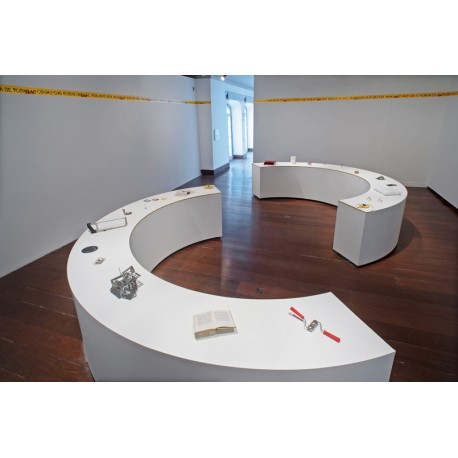
Medida de Todas as Coisas
Exposição
[HELENA TRINDADE]
Medida de Todas as Coisas, 2018
Exposição A letra é a traça da letra
Paço Imperial
Curadoria Glória Ferreira
Foto de Beto Felício
INSTALAÇÃO MEDIDA DE TODAS AS COISAS
Exposição A letra é a traça da letra
Paço Imperial
Curadoria Glória Ferreira
Foto de Beto Felício-O-OLHAR.jpg)
SOB(RE) O OLHAR, 2016
Narciso de Caravaggio impresso em acetato em forma de banda de Moebius + espelho.
18 x 18 x 7 cm

MAGIC EYE 2016
Travesseiro infantil + olho mágico
40 x 25 x 10 cm
INSTALAÇÃO MEDIDA DE TODAS AS COISAS
Exposição A letra é a traça da letra
Paço Imperial
Curadoria Glória Ferreira
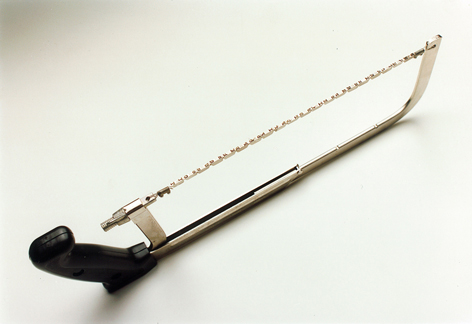
POEMA A DERRIDA, 2008
Arco de serra + tipos de máquina de escrever
43 x 13 x 3 cm
INSTALAÇÃO MEDIDA DE TODAS AS COISAS
Exposição A letra é a traça da letra
Paço Imperial
Curadoria Glória Ferreira
Foto de Beto Felício
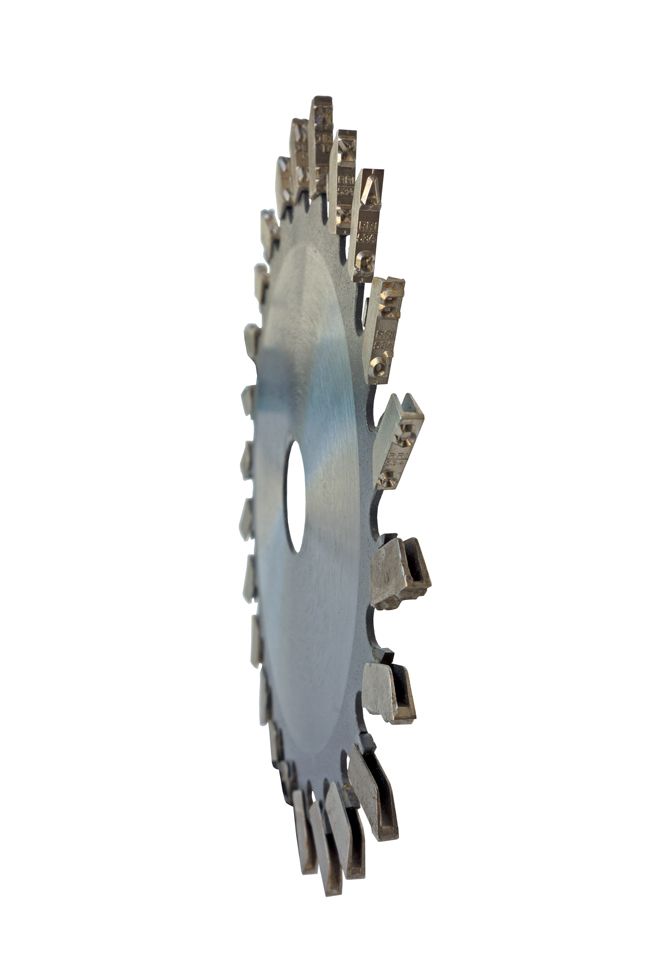
CORTE SECO, 2018
Serra circular + tipos de máquinas de escrever
12,5 x 12,5 x 0,2 cm
INSTALAÇÃO MEDIDA DE TODAS AS COISAS
Exposição A letra é a traça da letra
Paço Imperial
Curadoria Glória Ferreira
A letra é a traça da letra |no Instituto Tomie Ohtake
Letras e abecedários estão presentes em profusão nas diversas instalações da exposição “A letra é a traça da letra”, de Helena Trindade. Alfabetos latinos que não são segmentais, mas estão em processos de construção, destruição e reconstrução. Os trabalhos remetem-se uns aos outros e estabelecem um amplo campo de Poesia Visual – traço comum na poética da artista, há mais de vinte anos.
Se o alfabeto contém, em princípio, todas as palavras, presentes, passadas e futuras, a artista afirma que elas “são flagradas antes de significarem. Esse vazio que a letra diz coloca a máquina em movimento, ao mesmo tempo em que determina que ela não cesse de dar a ver o seu trabalho como uma deriva poética que assume configurações diversas.”1 Configurações que buscam uma topologia entre o enunciável e o visível, embora o enunciável não se configure como linguagem propriamente. Ou, como assinala Giorgio Agamben, “Lá onde acaba a linguagem, não é o indizível que começa, mas a matéria da língua”. 2
Iniciada no Paço Imperial, em março de 2018, a exposição tem diversas formalizações, os alfabetos constituindo diferentes instalações, também agora, no Instituto Tomie Ohtake. A (a)MURO, que abre a mostra, tem dois muros (des)construídos a partir de estênceis de letras. Eles abordam, segundo a artista, aspectos do funcionamento da linguagem e evocam Lacan, que se refere a um “muro de linguagem que se opõe àfala”3. Remetem também ao neologismo lacaniano (a)mur, que conjuga as palavras “amor” e “muro”. Um destes muros fará parte da ação performática Nada terá tido lugar senão o lugar, que destacará, com suas torções, o vazio das letras. Os Vírus, que os acompanham, espécie de formas orgânicas, construídos com teclas e hastes de máquinas de escrever, parecem ameaçadores, sendo que um deles atravessa um muro.
Os Vírus encadeiam-se igualmente ao Alfabeto traça, que compõe outra instalação.Também realizado com teclas e hastes de máquina de escrever com as letras apagadas, é autorreferente, não correspondendo a nenhum alfabeto conhecido. Não deixa de lembrar o que diz Tania Rivera em seu novo livro, Fora da imagem (foto)grafias: “Tem o alfabeto, as 23 letras com as quais se faz o mundo. E tem o inalfabeto:o avesso desses desenhos. Aquele que desfaz as palavras, fazendo ruir a língua e revirando a gramática. Fazendo aparecer o mundo, enfim, o mundo e suas arestas”.4
Uma série de fotografias de grande formato, o Alfabeto traço, reproduz desenhos com estênceis de todas as letras do alfabeto, umas sobre as outras que, superpostas, geram relevos, rastros, apagamentos etc. Acompanha o objeto Tempo para compreender, que consiste em dois relógios com mostradores de letras, sendo que um deles funciona no sentido anti-horário.
Em outra parede, é projetado o vídeo D’Écrits & Des Cris (Escritos & Gritos), no qual o corpo da performer, a atriz Ana Kfouri, se presentifica sempre aos pedaços ou por intermédio de sombras e gritos. Ao lançar estênceis de letras de metal, ela vai criando uma espécie de grande partitura, formada no chão do galpão onde o vídeo foi realizado.
Tal utilização de letras não deixa de remeter a Jasper Johns e suas pinturas, consideradas por Luc Lang5 não ícones, mas objetos, tomando como ponto de partida, segundo Johns, “elementos exteriores pré-formados, convencionais, despersonalizados, factuais” 6, tais como seus quadros Numbers in Color, 1958-59, com números sequenciaisde 0 a 9 cobrindo toda a superfície. Entre outros, destaca-se o 0-9, 1959, com apenas uma sequência. Ainda segundo Luc Lang, o que podemos ver no trabalho de Johns não é a representação de temas como a Anunciação, mas a repetição “de figuras fortemente abstratas, quer dizer, de signos numéricos ou linguísticos, apreensíveis uma vez mais”.7
Mais próximo de nós, a utilização de letras não deixa também de remeter aos trabalhos de Mira Schendel, nos quais diversos elementos, tais como linhas, palavras, rabiscos e letras, são utilizados como sinais gráficos inesperados, “manifestações de uma pura presença, casual ou impositiva, vaga ou agressiva, evanescente ou contundente, pulsar gráfico sem começo ou fim”8, como assinala Paulo Venancio Filho.
Como elemento de passagem, Floresta de casulos, construída de papel branco e barbante de encadernação, se relaciona com os Vírus e exigeque, em sua travessia, o público sensorialmente nela roce, alterando suas formas. Os papéis têm as formas orgânicas dos que foram retirados de um dicionário etimológico, cujas fissuras foram incrustadas com pequenostipos de máquina de escrever, dando origem à A letra é a traça da letra, também presente na exposição. Cada casulo tem o mesmo número de recortes daqueles retirados do dicionário e guarda a mesma sequência da perfuração nele efetuada. Funcionam como escalas que se deformam com a ação da gravidade.
Segundo a artista, “de forma alegórica, é como se a instalação (a)MURO fosse um campo de forças em ‘inter-ação’. Um polo impuro do tempo: o vídeo D’Écrits & Des Cris (Escritos & Gritos), a ação Nada terá tido lugar senão o lugar e a instalação Floresta de casulos; e um outro polo impuro, do espaço: o (a)Muro, as fotografias Alfabeto traço e os Vírus. Entre os dois polos estaria o Tempo para compreender (...)”.9
Atravessando a Floresta de casulos, chegamos à instalação (A)MOR, que destaca as letras A, M, O, R, relacionando-se, assim, à primeira sala. O vídeo Afastamentos aborda o afeto amoroso através da ironia, o amor tomado por suas letras pode não ser o que parece... Somente ao final desse vídeo percebemos que ele foi realizado a partir de fotos do Google Maps e que o letreiro semidestruído, onde se lê a palavra amor, na realidade pertence a uma oficina de amortecedores. No meio da sala, em uma grande mesa de 3.00m de diâmetro, está Insular, uma escultura construída com os recortes retirados do trabalho A letra é a traça da letra. Completa a instalação o díptico A-M-O- R, que coloca em questão alguns momentos diversos do afeto amoroso. São dois vídeos projetados no chão da sala, sendo um dinâmico e vertiginoso, com música eletrônica, e o outro mais plácido e suave, com música da Grécia Antiga. As pessoas poderão atravessá-lo, projetando suas sombras e deixando-se “banhar” pelas imagens. A sala estará na penumbra, apenas iluminada pelos vídeos e um pequeno fachode luz sobre o Insular.
Em Medida de todas as coisas, com 22 objetos, são várias as referências, a começar pelo sofista grego Protágoras, cuja frase está inscrita em duas trenas que circundam as bancadas em que esses objetos estão dispostos: “O homem é a medida de todas as coisas, das coisas que são, enquanto são, das coisas que não são, enquanto não são”. Esta frase para a artista sinaliza “uma condição necessária: o engajamento do homem com proposições no campo da arte é sempre singular, uma vez que é a sua visada que transmuta as coisas ‘em obras’.”10 Alguns desses objetos remetem aos objetos a de Lacan – a voz, o olhar, o seio e as fezes –, conceituados, grosso modo, como “objetos-causa de desejo” e “algo de que o sujeito, para se constituir, se separou como órgão.” O objeto a “vale como símbolo da falta”, não como tal, “mas como fazendo falta”.11 O interesse de Helena por Lacan é de longa data e tem grande presença em sua poética, tendo a artista participado, entre outros, de seminários sobre Arte e Psicanálise na UFRJ.
Outros trabalhos desta instalação remetem também ao corpo e à letra, e a diversos autores e artistas, como o poeta catalão Joan Brossa, com o Poema a Brossa, composto com carta de baralho, um ás de ouro, e carro de fricção, fazendo alusão à carta=letter=letra, tensionando a visualidade e a letra. Ou ainda a Heidegger, cujo livro A origem da obra de arte é retomado pela artista e impresso de modo a reproduzir a cada folha seu título, salvo nas duas páginas centrais, como a mostrar a vacuidade da promessa do filósofo, jamais realizada. Por sua vez, o Poema a Derrida, em que pequenos tipos de máquina de escrever fazem as vezes de uma serra, remete ao conceito de desconstrução proposto pelo filósofo. Já em Sob(re) o olhar, 2016, a artista recortou a figura de Narciso, de Caravaggio, e a imprimiu em acetato em forma de banda de Moebius, para colocá-la sobre um pequeno espelho redondo. Em Ovídio, Narciso se “apaixona por uma ilusão sem corpo” 12, refletida “numa fonte cujas águas brilham como a prata”13, e, no caso deste trabalho de Helena, não tem dentro nem fora, conforme a fita de Moebius, e reporta-se ao olhar em Lacan, considerado nosso primeiro aparelho de coordenação do espaço, que começa a percebê-lo, registrá-lo e organizá-lo. A instalação também traz utensílios, livros, brinquedos e outras coisas que demonstram um vazio ativo, tal como a máquina Olivetti, vermelha, sem tipos nem teclado, ou seja, banguela, que recebe o título de Oráculo. Ou ainda Carta a Lygia, em que o Bicho, dessa artista, se transmuta em letras em estênceis de metal articulados por dobradiças e passíveis de serem manipulados pelo público. Por fim, temos ainda A carta roubada, referência ao conto de Edgar Allan Poe, em que a carta (letter) permaneceu escondida enquanto restava bem à vista de todos.
Segundo a artista, “existe no movimento que gera a linguagem um trabalho perpétuo de rearticulação que problematiza a questão da origem, uma vez que nesse processo nada se produz que não seja pela transformação”.14
O Alfabeto traça, também já comentado, é disposto na parede como em um caderno de caligrafia. Sem código, dialoga com a destruição do muro da linguagem pelo Vírus e com a apresentação das coisas do amor e do desejo, nas outras instalações. Arremata o encadeamento de todos os trabalhos.
Os títulos têm grande relevância nos trabalhos de Helena; são poéticos e indicam de certa maneira a origem de suas ficções. O título, com suas diferentes acepções ao longo da história, é o lugar em que os pensamentos se alojam para aí se diluírem. Ou, como assinala Michel Butor, "uma espécie de modo de instrução, anunciador ou mestre de cerimônia que faz ver a obra de uma certa maneira e, permanecendo, nos vigia."15 Assim acontece com o próprio título da exposição: “A letra é a traça da letra”. O tempo é a pior traça, pois corrói ou destrói insensivelmente, paulatinamente, assim como os diversos alfabetos utilizados. Para a artista, a letra é “um ‘pré-texto’ para um jogo poético”, em permanente arranjo e desdobramento, no limite do indizível. Tomando emprestadas as palavras de Adolfo Montejo Navas sobre o trabalho de Wlademir Dias-Pino, “nofundo, estamos no campo da poesia como imagem antes da palavra, da constituição da linguagem, no pré-logos, na poesis primigênia”,16 ou na limitação da “ação elocutória do poeta”, como disse Mallarmé.
Para a artista, “se o sentido da 'poética da letra' é percorrer um espaço de indeterminação que ela nunca cessa de constituir, a construção de pontes entre letras, imagens e psiquismo, no que este se liga ao 'ato criador', é um trabalho moebiano e infinito e, mesmo que não se possa conceber que existam regras para isto, o que aqui esteve, desde o princípio, em questão”.17 Romper a forma linear da escrita, tratar a letra como vetor de significados, um contínuo trabalho de rearticulação, próprio ao funcionamento da linguagem, é o que, a meu ver, Helena Trindade realiza em sua poética.
Glória Ferreira
Fevereiro / junho 2018
Notas:
1 TRINDADE, Helena. Texto de apresentação do projeto.
2 AGAMBEN, Giorgio. Idée de la prose. França: Christian
Bourgois, 1998. Trad. fr. Gérard Macé.
3 LACAN, Jacques. “Função e campo da fala e da linguagem”. Escritos. Rio de Janeiro, Jorge Zahar Editor, 1998.
4 RIVERA, Tania. Fora da imagem (foto)grafias. Rio de Janeiro: Tania Rivera, 2017.
5 LANG, Luc. “La peinture inutile”. In: Revista Arstudio. Spécial Jasper Johns. Paris, n. 12, primavera 1989.
6 JOHNS, Jasper apud David Sylvester. "Entretien avec Jasper Johns". In: Op. cit.
7 LANG, Luc. Op. cit.
8 VENANCIO FILHO, Paulo. Sinais / Signals Mira Schendel. In: http://mam.org.br/exposicao/sinais-signals-mira-schendel/
9 TRINDADE, Helena. Texto inédito.
10 Ibidem.
11 LACAN, Jacques. O Seminário: livro 11: os quatro conceitos fundamentais da psicanálise. Rio de Janeiro, Jorge Zahar Editor, 1990.
12 OVIDE. Les Métamorphoses. Paris: Gallimard, 1992.
13 DAMISH, Huber. "Narciso barroco". In: Revista Arte&Ensaios, Ano VI, n. 4, 1999.
14 TRINDADE, Helena. Texto inédito.
15 BUTOR, Michel. Les Mots dans la Peinture. Genève: Albert Skira, 1969.
16 NAVAS, Adolfo Montejo. "Subversões e mônadas visuais". In: Poesia visual. Rio de Janeiro: Oi Futuro, 2013.
The letter is the bookworm of the letter
Letters and alphabets inundate the various installations of Helena Trindade’s exhibition A letra é a traça da letra (The letter is the bookworm of the letter). Latin alphabets not segmentally transcribed, but rather in the process of construction, destruction and reconstruction. The works refer to each other and establish a broad field of visual poetry – a common feature of Trindade’s art for more than twenty years.
Considering that the alphabet, in principle, contains all words, present, past and future, the artist asserts that “they are caught before signifying. This void that the letter speaks sets the machine in motion, and simultaneously determines that it will not stop revealing its work as a poetic wandering that assumes various configurations.”1 Configurations that seek a topology between the utterable and the visible, although the utterable is not configured as a language per se. Or, as Giorgio Agamben maintains, “Where language ends is not where the unsayable begins, but rather the matter of language.” 2
Firstly exhibited at Paço Imperial, in March 2018, and now at Instituto Tomie Ohtake, the exhibition includes several formalisations, the alphabets constituting different installations. Opening the exhibition, (a)MURO has two walls (de)constructed from letter stencils. According to the artist, they address functional aspects of language, with a nod to Lacan, who referred to a “wall of language that blocks speech.”3 They also speak to the Lacanian neologism a(mur), which combines the words amor (love) and muro (wall). One of these walls features in the performance Nada terá tido lugar senão o lugar (Nothing will have had place but the place), which will highlight, with its twists, the emptiness of letters. The Viruses which accompany them, kind of organic forms made of typewriter keys and bars, take on a threatening appearance as one of them marches through a wall.
The Viruses then lead into another work, Alfabeto traça (Alphabet bookworm), which constitutes another installation.Also made from typewriter keys and bars, with the letters rubbedout, it is self-referent, bearing no correspondence with anyknown alphabet. It brings to mind Tania Rivera in her new book Fora da imagem (foto)grafias: “There is the alphabet, the 23 lettersout of which the world is made. And there’s the unalphabet: thereverse of these drawings. Those that undo words, causing languageto founder and turning grammar upside down. Making theworld appear, in short, the world and its edges.”4
A series of large-scale photographs, Alfabeto traço (Alphabet trace), reproduces drawings with stencils of all the letters of the alphabet, superimposed on one another to generate reliefs, tracks and erasures. Beside it one finds the object Tempo para compreender (Time to comprehend), which is composed of two clocks with letters instead of numbers on their faces, one of which revolves anti-clockwise.
On another wall, the video D’Écrits & Des Cris (Writings & Screams) is screened, in which actress Ana Kfouri’s body is brought to us always in pieces or by means of shadows and screams. Throwing metal letter stencils, she gradually creates a kind of large musical score on the floor of the warehouse where the video was shot.
Such use of letters somewhat resembles Jasper Johns and his paintings, considered by Luc Lang5 not as icons, but rather objects, taking as their starting point, according to Johns, “preformed external, conventional, depersonalized, factual elements,”6 such as his paintings Numbers in Color, 1958-59, with sequences of numbers from 0 to 9 covering the entire surface. One can highlight among them, 0-9, 1959, which presents just one sequence. Still according to Luc Lang, what we can see in Johns’ work is not the representation of themes like the Annunciation, but the repetition “of strongly abstract figures, that is, of numeric or linguistic signs, once again apprehensible.”7
Nearer to us, the use of letters reminds us of the works of Mira Schendel, in which various elements, such as lines, words, scribbles and letters, are used as unexpected graphic signs, “manifestations of a pure presence, casual or imposing, vague or aggressive, evanescent or striking, graphic pulse with no beginning or end”8, quoting Paulo Venancio Filho.
Providing a passageway onwards,Floresta de casulos (Forest of cocoons), made from white paperand bookbinding string, is related to the Viruses and requires the public, as they walk through, to rubagainst it in sensorial way, changing its forms. The sheetsof paper have the organic shapes of those that have beencut out of an etymological dictionary, the edges of whichare encrusted with small typewriters types, giving rise tothe The letter is the bookworm of the letter also shown in the exhibition.Each cocoon has the same number of cuttingsas those taken from the dictionary and bears the samesequence of perforations made on it. They function likescales that are deformed under the force of gravity.
According to the artist, “allegorically speaking, it is as if the installation (a)MURO were a force field in ‘inter-action’. An impure pole of time: the video D’Écrits & Des Cris (Writings & Screams), the action Nada terá tido lugar senão o lugar (Nothing will have had place but the place) and the installation Floresta de casulos (Forest of cocoons); and another impure pole of space: (a)Muro, the
photographs Alfabeto traço (Alphabet trace) and the Viruses. Between the two poles we can find Tempo para compreender (Time to comprehend) (...).”9
Walking through the Forest of Cocoons, we reach the installation (A)MOR, which highlights the letters A, M, O, R, thus relating to the first room. The video Afastamentos (Apartness) deals with loving affection through irony, love taken by its letters may not be what it seems... Only at the end of this video we perceive that it was created with photos from Google Maps, and that the semi-destroyed sign, where one reads the word love (amor in Portuguese), is in fact part of a car bumper (AMORtecedor in Portuguese) repair shop sign.
In the middle of the room, on a large, 3-metre diameter table, we find Insular, a sculpture built from the cuttings taken from the work The letter is the bookworm of the letter. The diptych A-M-O-R completes the installation, bringing into question several different moments of love. Two videos projected onto the floor form this work. One is dynamic and dizzying, with electronic dance music, while the other is more placid and calm, with music from Ancient Greece. People can walk through it, casting their own shadows and allowing themselves to be “bathed” in the images. The room will be dark, illuminated only by the videos and a small beam of light shining over Insular.
Medida de todas as coisas (Measure of all things), presents 22 objects, making several references, starting with the Greek sophist Protagoras, whose quote is inscribed on two tape measures that circumvent two wooden stands on which these objects are displayed: “Man is the measure of all things, of those that are that they are, and of those that are not that they are not.” This phrase, for the artist, signals “a necessary condition: the engagement of man with propositions in the field of art is always singular, since it is his envisagement that transmutes the things in to works.”10. Some of these objects refer to Lacan’s objets petit a – the voice, the gaze, the breast and the feces, classified, in rough terms, as “objects cause of desire” and “something which the subject, in order to constitute itself, has separated itself off as organ.” The objet petit a “serves as a symbol of the lack”, not as such, “but in so far as it is lacking.”11 Helena’s long-standing interest in Lacan is abundantly evident in her works, with the artist having partaken in seminars about Art and Psychoanalysis at UFRJ (Rio de Janeiro Federal University), among others.
Other works of this installation also bring to mind the body and the letter, and several authors and artists, such as the Catalan poet Joan Brossa, with her Poema a Brossa, composed with a playing card, a golden Ace, and a friction car, alluding to letter through the Spanish (and Portuguese) word carta (which can mean card and a letter written by someone to someone else), straining the visual effect and the letter. Or even Heidegger, whose book The Origin of the Work of Art is borrowed by the artist and printed in order to reproduce its title on each page, except for on the two middle pages, as if to show the emptiness of the philosopher’s never-fulfilled promise. In turn, the Poema a Derrida (Poem to Derrida), in which small typewriter types form the teeth of a saw, speaking to the concept of deconstruction proposed by the philosopher. In Sob(re) o olhar, 2016, the artist cut out the figure of Caravaggio’s Narcissus, printed it in acetate in the shape of a Möbius strip, and placed it on a small round mirror.In Ovid, Narcissus “falls in love with a bodiless illusion,”12 reflected “in a pool of water that glittered like silver,”13 and, in the case of this work by Helena Trindade, there is no inside or outside, just like a Möbius strip, and refers to the gaze in Lacan, considered our first apparatus for space coordination, in which one starts to perceive, register and organise space. The installation also brings utensils, books, toys and other things that demonstrate an active void, such as the Olivetti machine; red, with no types or keys, to all effects, toothless, which is given the title Oracle. Or even Carta a Lygia (Letter to Lygia), in which Lygia Clarke’s Bicho (Creature) is transmuted into metal letter stencils joined together by hinges, which can be manipulated by the public. Finally we also have A carta roubada (The purloined letter), in reference to Edgar Allan Poe’s short story, in which the letter was hidden in plain sight.
According to the artist, “there is in the movement that generates language a perpetual rearticulating work that critically questions the origin, since in this process nothing is produced unless through transformation.”14
The Alphabet bookworm, also commented above, is arranged on the wall as if in a handwriting notebook. With no code, it dialogues with the destruction of the wall of language by the Virus, and with the things of love and desire presented in the other installations. It closes the chain of all the works.
The titles of Helena’s works are of great significance; they are poetic and in a way indicate the origin of their fictions. The title, with its different meanings over the course of history, is the place where thoughts are harboured to then be diluted. Or, as suggested by Michel Butor, “a kind of instruction mode, an announcer or master of ceremonies that reveals the work in a certain manner and, being maintained, watches over us.”15 Thus is the case with the title of the exhibition itself: “The letter is the bookworm of the letter.” Time is the worst kind of bookworm, as it corrodes or destroys insensitively, gradually, just like the various alphabets used. For the artist, the letter is a “pre-text for a poetical game”, in permanent arrangement and unfolding, at the limit of the unsayable. Borrowing the words of Adolfo Montejo Navas about Wlademir Dias-Pino’s work, “deep down, we are in the field of poetry as image before the word, of the constitution of language, in the pre-logos, in the primeval poesis,”16 or at the limit of the “poet’s elocutionary action”, as Mallarmé said.
For the artist, “if the sense of the ‘poetics of the letter’ is running through an indeterminate space that it never stops constructing, the building of bridges between letters, images and psychism, in which the latter is connected to the ‘act of creation’, is a Möbian and infinite
work, and even if the rules for this cannot be conceived, what has been here since the beginning is at stake.”17 Breaking from the linear form of writing, treating the letter as a vector of meanings, an ongoing work of re-articulation, intrinsic to the functioning of language, is what, in my opinion, Helena Trindade achieves in her art.
Glória Ferreira
